Amino Acid Analysis for Plant-Based Foods
Plant-based product developers send us patties, drinks, cheese alternatives and blends to check blend balance and what fermentation changed. AA-T gives most of the composition. Tryptophan and cysteine are not reported by AA-T, so it does not give a protein quality score alone.
Decisions this answers
- Is a pea and rice blend balancing the weak amino acid of each, or just adding cost?
- Did a protein supplier change move lysine or methionine?
- Has fermentation changed the free amino acid and glutamate pattern?
- Does the finished product keep the amino acids of its ingredients?
Blend balance
Cereal and legume proteins tend to be weak in different amino acids, which is why blends work. Measured values let you check that for your own ingredients.
| Amino acid | Cereal protein (rice, oat, wheat) | Legume protein (pea, soy, faba) |
|---|---|---|
| Lysine | Usually the limiting one | Usually richer |
| Methionine and cysteine | Usually richer | Usually the limiting ones |
| Tryptophan | Not reported by AA-T | Not reported by AA-T |
What AA-T reports and what it does not, for plant-based foods
- AA-T reports 16 amino acids after 6 N HCl hydrolysis at 110 °C for 24 hours, in g/100 g and mol%.
- Tryptophan is destroyed by the acid and is not reported.
- Cysteine and cystine are not reported in AA-T. Cysteine needs the AA-3 workup.
- Asparagine and glutamine convert to aspartate and glutamate, so they are reported with those two.
- Methionine can partly oxidize, so it can read low.
- Serine and threonine are partly lost during hydrolysis.
- Valine and isoleucine bonds hydrolyze slowly, so 24 hours can under-recover them.
Which test fits which product
| Product | Test | Notes |
|---|---|---|
| Patty, cheese alternative, protein blend (protein composition) | AA-T ($230) | Solids go through hydrolysis. Protein is locked in structure, so total is needed. |
| Plant drink (flavor or fermentation question) | AA-1 ($150) | Some amino acids are already free in solution. |
| Fermented product | AA-1 and AA-T | Free shows what fermentation changed. Total shows what the protein holds. |
| Dry blend or powder (free amino acids) | AA-1 plus PREP-1 if it needs extraction ($180) | A powder that simply dissolves in water needs no prep charge. |
Price
AA-1 is $150 per sample. Solids and powders that need extraction add PREP-1 at $30, for $180. AA-T is $230 including hydrolysis. Standing prices are $125 per sample at 15 or more samples a month and $99 at 30 or more. PACK-10 is $1,250 prepaid and PACK-25 is $3,125 prepaid, both for AA-1 samples. The minimum order is $150.
How much to send
Send at least 100 mg of solid, or 200 µL of liquid with 400 µL preferred, per sample. Send products as sold, and tell us before sending a fermented or refrigerated product so storage on arrival matches what it needs. Label each tube with the sample ID exactly as it appears on your sample sheet. Book online first. We confirm the start date by email and send the sample sheet and the shipping address.
Turnaround
Overnight turnaround available, with expedited service on request. Standard results in 3 to 5 business days from receipt. Tell us your sample count and type, and we'll confirm timing.
What the report shows
Every report includes the results table, the chromatogram and the run's calibration and QC results. See the example report (PDF).
AA-T results describe the amino acid composition of the sample as submitted. AA-1 results describe the free fraction only and are not a protein quality result. For how scores are built, see our guide to protein quality scores.
FAQ
Free or total, which do I need?
Total (AA-T) for protein composition, blend balance and label questions. Free (AA-1) for flavor, fermentation and process changes.
Can one run support a protein quality claim?
Not on its own. Protein quality scores such as PDCAAS and DIAAS need tryptophan and cysteine and a digestibility value. AA-T does not report tryptophan or cysteine, and we do not measure digestibility. AA-T gives the rest of the composition, which is enough to compare blends on lysine, methionine, threonine and the branched-chain amino acids.
Do you measure cysteine or tryptophan?
Free tryptophan is part of AA-1. After acid hydrolysis, tryptophan is destroyed and cysteine is not reported. Cysteine needs the AA-3 workup, priced after a free call.
Why would a fermented product need a free panel?
Cultures consume some amino acids and release others, and free glutamate drives savory taste. AA-1 shows that free pattern.
Are you accredited (ISO 17025, GLP or GMP)?
Not yet. Our testing supports research, product development and process monitoring. Every report includes the chromatogram, calibration and QC results, so you can see exactly how your numbers were made.
OpenChemWorks Laboratory · Reviewed by the OpenChemWorks laboratory · Updated November 19, 2026
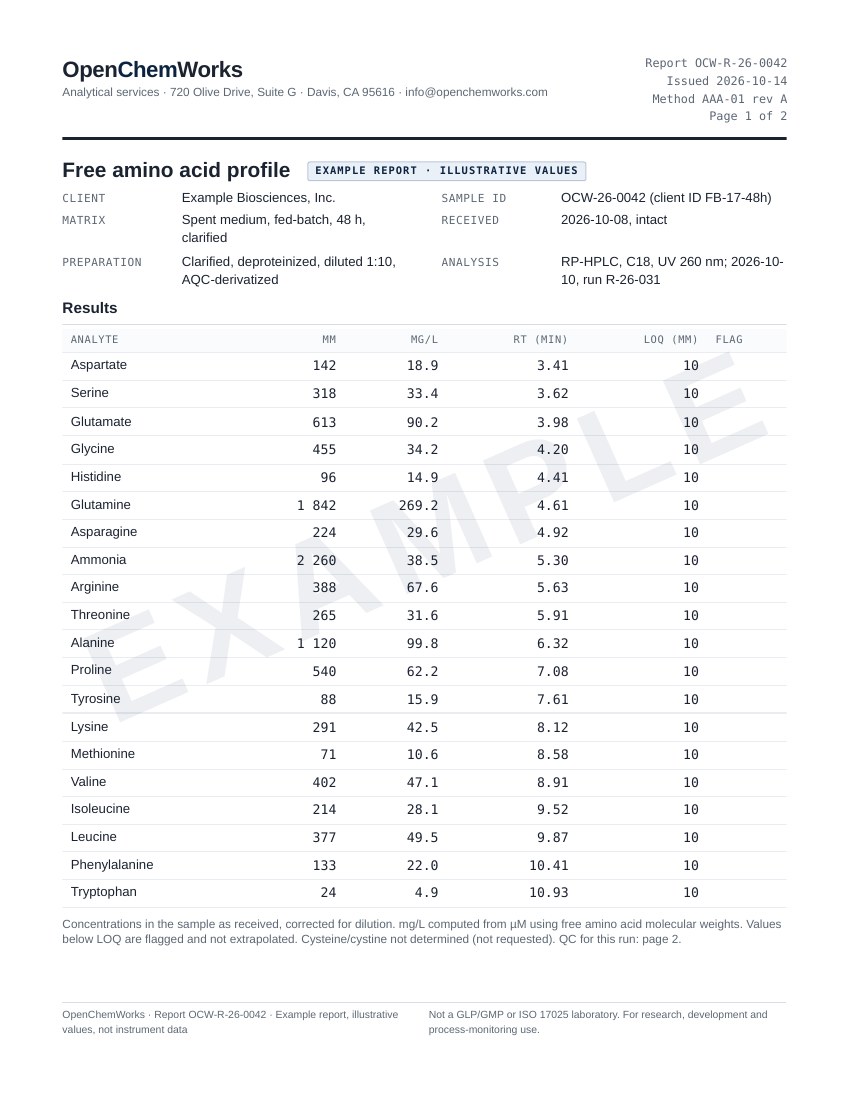
Every result comes with the data behind it.
Each report includes the results table, the chromatogram and the run's quality-control summary, so your methods section or process record has what it needs.
Keep exploring
Related pages: the method behind these results, and the matrices closest to yours.
Glutamate in plant-based foods
Free glutamate in plant-based foods.
Explore → GuideProtein quality scores, computed
How DIAAS-style ratings are computed.
Explore → ApplicationProtein powders, bars and shakes
Powders, bars and shakes.
Explore → ApplicationProtein hydrolysates and peptones
Hydrolysates, peptones and yeast extracts.
Explore → MethodAcid hydrolysis of proteins
What acid hydrolysis does to each amino acid.
Explore →Ready to send samples?
Overnight turnaround available, with expedited service on request.
Order online at the order builder, or email info@openchemworks.com with your sample type and the decision the result will feed. We will confirm timing and the shipping details by email.