Amino Acid Analysis for Plasma
Plasma amino acid analysis for research, from as little as 15 µL per sample. We measure 19 amino acids plus ammonia by AQC derivatization and HPLC with UV and fluorescence detection at $150 per sample. Research use only, not for clinical diagnosis.
Research use only
Plasma and other human samples are tested for research use only. Results are not for clinical diagnosis or treatment decisions.
What we measure in plasma
Plasma carries the free amino acids circulating in blood. We measure 19 amino acids plus ammonia in µmol/L by AQC pre-column derivatization and HPLC with UV and fluorescence detection, the same method as AA-1. Our minimum volume is 15 µL per sample, enough for the full panel from one run, so a small aliquot should not decide whether a sample can be tested.
To compare your numbers with published intervals, see our guide to plasma amino acid reference intervals. It harmonizes two published sets of intervals and explains where they disagree. Those intervals are a research comparison, not a diagnostic reference.
Handling and ammonia
- Ammonia rises in plasma that sits unprocessed and in hemolyzed plasma. Separate plasma promptly, cap it, and freeze it.
- Tell us the anticoagulant and how long blood sat before separation, so the record is complete.
- Handle every sample in a cohort the same way. Differences in handling can look like differences between groups.
Not in the standard panel
The panel covers 19 amino acids and ammonia. Cystine, taurine, citrulline and ornithine, which many plasma panels include, are not part of it. Taurine is available as AA-1 (Taurine) at the same $150. Citrulline and ornithine are on AA-2, and cysteine and cystine on AA-3, both priced after a free 30-minute feasibility call.
Who sends plasma
- Study samples where each subject or time point is one small aliquot
- Repeat profiles measured the same way across a cohort or time course
- Small-volume samples that cannot spare the 200 µL or more many panels ask for
- Checking a single cohort against a published interval before a larger run
Price
AA-1 on plasma is $150 per sample. Standing prices are $125 per sample at 15 or more samples a month and $99 at 30 or more. PACK-10 is $1,250 prepaid and PACK-25 is $3,125 prepaid. The minimum order is $150.
How much to send
Send from 15 µL of plasma per sample. Label each tube with the sample ID exactly as it appears on your sample sheet. Book online first. We confirm the start date by email and send the sample sheet and the shipping address. Email us before sending frozen samples if you want arrival handling agreed.
Turnaround
Overnight turnaround available, with expedited service on request. Standard results in 3 to 5 business days from receipt. Tell us your sample count and type, and we'll confirm timing.
What the report shows
Every report includes the results table, the chromatogram and the run's calibration and QC results. See the example report (PDF).
Each amino acid and ammonia are listed individually in µmol/L, with the chromatogram and the run's QC summary behind the numbers.
FAQ
How much plasma do I need to send?
As little as 15 µL per sample. That is enough for the full panel, 19 amino acids plus ammonia, from one run.
How much does plasma amino acid analysis cost?
$150 per sample. Standing orders pay $125 per sample at 15 or more samples a month and $99 at 30 or more. New customers can start with a $250 pilot of 5 samples, credited in full toward a first order of 20 or more samples within 90 days.
Is this for clinical diagnosis?
No. Plasma and other human samples are tested for research use only, not for clinical diagnosis.
Which common plasma analytes are not in the standard panel?
Cystine, taurine, citrulline and ornithine. Taurine is available with AA-1 (Taurine). Citrulline and ornithine are on AA-2, and cysteine and cystine on AA-3, both priced after a free call.
How should I handle plasma for ammonia?
Separate plasma promptly, keep it capped, and freeze it. Ammonia rises in unprocessed or hemolyzed plasma, so tell us the anticoagulant and how long it sat before separation.
What does the report contain?
The concentration of each amino acid and ammonia, the chromatogram behind the numbers, and the QC summary for the run. Every sample carries an internal standard, and every run includes calibration and a QC standard.
OpenChemWorks Laboratory · Reviewed by the OpenChemWorks laboratory · Updated November 19, 2026
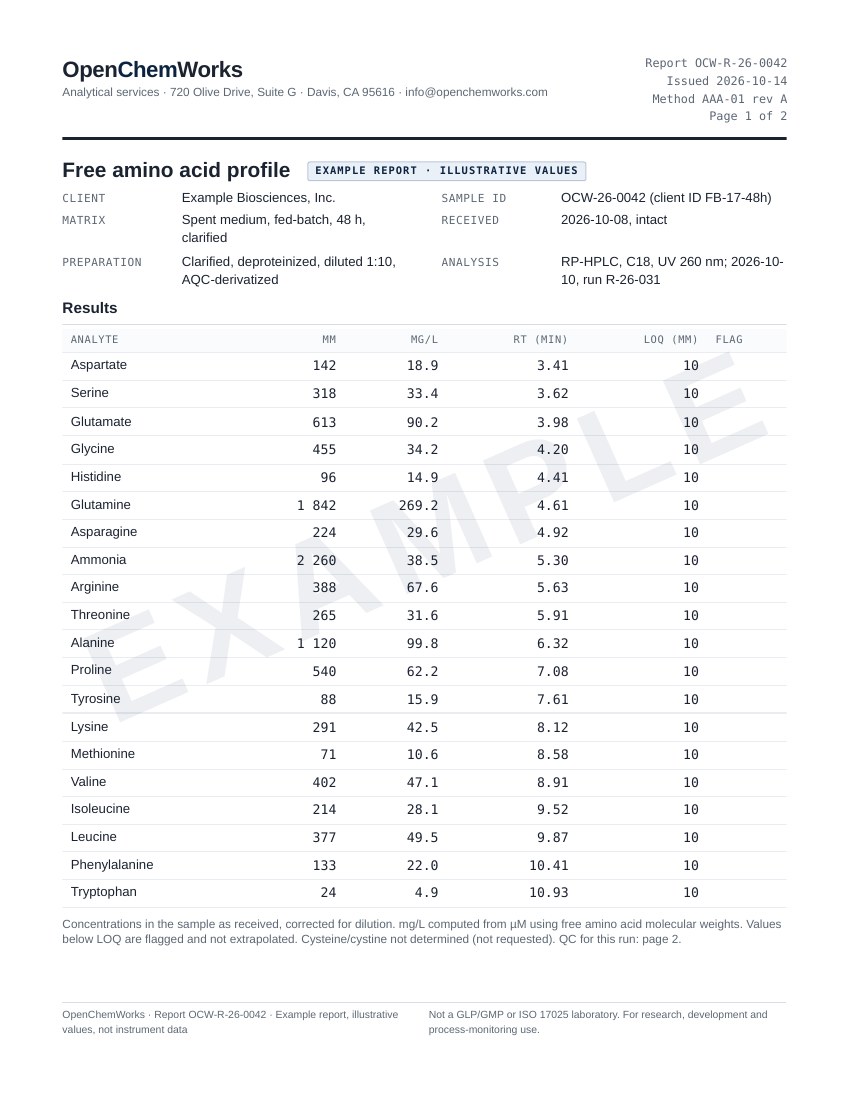
Every result comes with the data behind it.
Each report includes the results table, the chromatogram and the run's quality-control summary, so your methods section or process record has what it needs.
Keep exploring
Related pages: the method behind these results, and the matrices closest to yours.
Judging plasma results? Plasma amino acid reference intervals harmonizes the published Mayo and ARUP intervals and sets out what to ask before you send plasma.
Plasma amino acid reference intervals
Published intervals, where they disagree, and what to ask before you send plasma.
Explore → ServiceAmino acid analysis
AA-1 method, deliverables and published prices.
Explore → MethodHow we control quality
How each run is controlled.
Explore → ReferenceAnalytes reference
Analytes we report.
Explore →Ready to send samples?
Overnight turnaround available, with expedited service on request.
Order online at the order builder, or email info@openchemworks.com with your sample type and the decision the result will feed. We will confirm timing and the shipping details by email.