Amino Acid Analysis for Cell-Free Supernatants
Cell-free expression groups send us reaction supernatants to see which amino acid substrates ran short. A start sample or extract blank makes the profile interpretable. This page also covers IVT process samples, where amino acid analysis is not an mRNA test.
What a cell-free supernatant is
Cell-free systems run protein synthesis in a lysate without living cells. Amino acids go in as substrates, protein comes out, and the supernatant left at the end records how the reaction behaved. Researchers send supernatants when yield drops, a lysate batch changes, or a recipe is being tuned and the question is which substrates ran short.
The extract brings an amino acid and ammonia background of its own, which can differ between preparations. A supernatant profile read without a starting mixture or extract-only blank can mislead, because a high value may be leftover substrate or lysate background. Paired samples, reaction start and end, with an extract blank alongside, turn a profile into an answer. We do not subtract a background you did not submit a blank for.
What we measure
AA-1 reports 19 amino acids plus ammonia in µM and mg/L. Cell-free reactions work from free amino acids, so the question is normally the free pool before and after the reaction. Read it three ways: depletion shows which substrates the reaction drew down hardest, persistence shows what was supplied in excess, and ammonia tracks a by-product of amino acid breakdown in the extract.
The panel does not measure your product protein, energy substrates or nucleotides, and an amino acid profile alone does not explain every yield problem. Cysteine is not in AA-1 and needs AA-3.
IVT and mRNA process samples
In vitro transcription makes mRNA from a DNA template. It is not an amino acid process, and amino acid analysis is not an mRNA test. It fits only where protein and amino acids are genuinely part of the sample: enzyme preparations used in the process, protein-bearing intermediates, purification fractions where residual protein is the question, and buffers where an amino acid and ammonia profile is part of characterization.
- Enzyme preparations: AA-T gives the amino acid composition of the protein, useful for comparing lots. It does not measure whether the enzyme works.
- Residual protein in a purification fraction: profile fractions before and after the step. Tell us the expected protein level and we will confirm whether a measurement can answer it.
- Buffers and intermediates: AA-1 profiles the free amino acids and ammonia.
If your question is RNA yield, integrity or nucleotide content, we will say so before you send samples.
If you choose AA-T, what it reports and what it does not
- AA-T reports 16 amino acids after 6 N HCl hydrolysis at 110 °C for 24 hours, in g/100 g and mol%.
- Tryptophan is destroyed by the acid and is not reported.
- Cysteine and cystine are not reported in AA-T. Cysteine needs the AA-3 workup.
- Asparagine and glutamine convert to aspartate and glutamate, so they are reported with those two.
- Methionine can partly oxidize, so it can read low.
- Serine and threonine are partly lost during hydrolysis.
- Valine and isoleucine bonds hydrolyze slowly, so 24 hours can under-recover them.
Price
AA-1 is $150 per sample for a liquid. AA-T is $230 including hydrolysis. A solid that needs extraction adds PREP-1 at $30. Each condition and time point is one sample, and blanks and starting mixtures are samples too. Standing prices are $125 per sample at 15 or more samples a month and $99 at 30 or more. The minimum order is $150. A pilot of 5 AA-1 samples is $250.
How much to send
Send 200 µL of clarified supernatant per sample, with 400 µL preferred, or at least 100 mg of solid. State the reaction type, the time point and what it should be compared against, and send the starting mixture or extract blank if you have one. Freeze promptly. Label each tube with the sample ID exactly as it appears on your sample sheet. Book online first. We confirm the start date by email and send the sample sheet and the shipping address.
Turnaround
Overnight turnaround available, with expedited service on request. Standard results in 3 to 5 business days from receipt. Tell us your sample count and type, and we'll confirm timing.
What the report shows
Every report includes the results table, the chromatogram and the run's calibration and QC results. See the example report (PDF).
For paired or blank-matched sets, results are listed sample by sample under your labels so start to end change is readable. Lysate supernatants are dense matrices, so a PREP-2 spike-recovery check is advised for a new extract type.
FAQ
How is this different from spent media?
Spent media comes from living cells over days in a defined medium. A cell-free supernatant comes from a lysate reaction over hours, with an extract background that a defined medium does not have. The controls differ.
Do I really need a blank or starting sample?
For depletion claims, yes. Without one, the profile describes the end state only, and lysate background cannot be separated from leftover substrate.
Does amino acid analysis test my mRNA?
No. It profiles amino acids and ammonia in process and protein-bearing samples around an IVT step. RNA yield, integrity and purity need RNA methods.
Free or total for an enzyme preparation?
Total (AA-T) if the question is the protein composition. Free (AA-1) if the question is the amino acid and ammonia background of its buffer. Neither measures enzyme activity.
Are you accredited (ISO 17025, GLP or GMP)?
Not yet. Our testing supports research, product development and process monitoring. Every report includes the chromatogram, calibration and QC results, so you can see exactly how your numbers were made.
OpenChemWorks Laboratory · Reviewed by the OpenChemWorks laboratory · Updated November 19, 2026
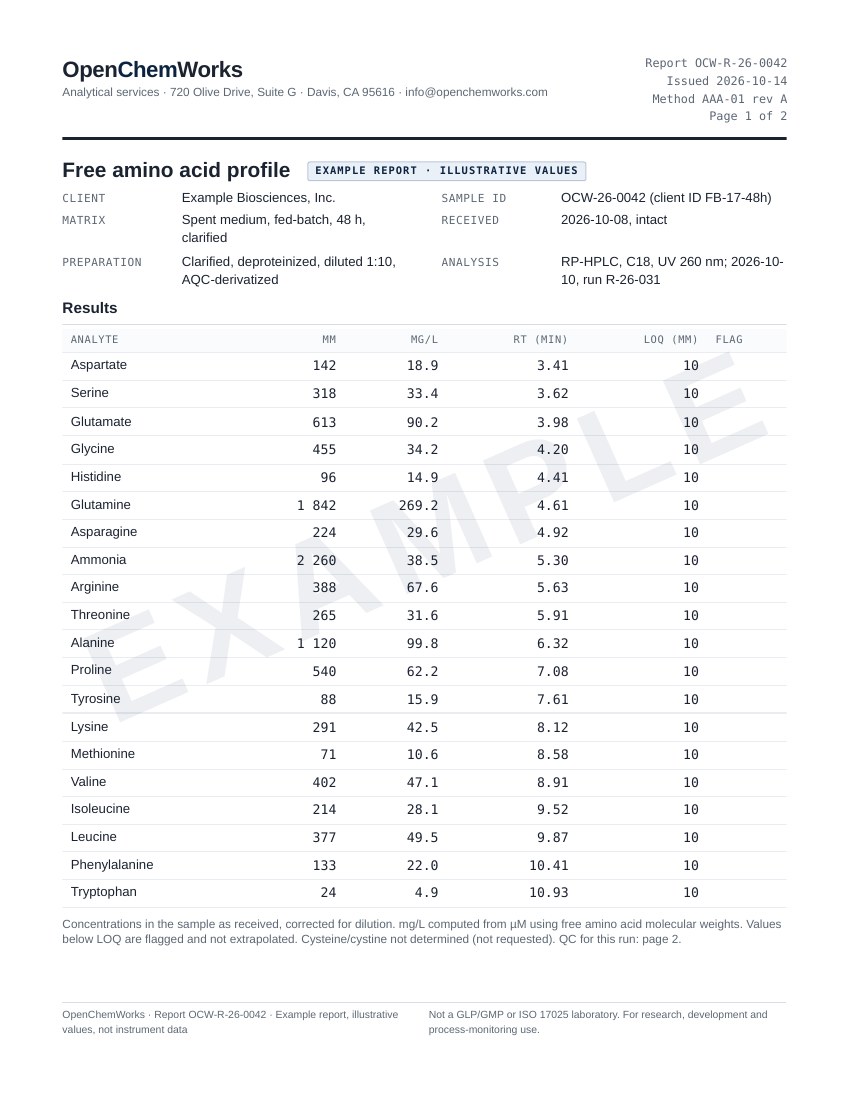
Every result comes with the data behind it.
Each report includes the results table, the chromatogram and the run's quality-control summary, so your methods section or process record has what it needs.
Keep exploring
Related pages: the method behind these results, and the matrices closest to yours.
Ready to send samples?
Overnight turnaround available, with expedited service on request.
Order online at the order builder, or email info@openchemworks.com with your sample type and the decision the result will feed. We will confirm timing and the shipping details by email.