Amino acid analysis for spent media
Spent media records what your cells took, what they left, and what built up along the way. We measure the free amino acid profile and ammonia, so feed decisions rest on the culture's actual consumption — not habit.
What spent media tells you
A spent sample is typically a clarified supernatant drawn from a culture at a stated day and condition. It contains the amino acids the culture did not use, depleted levels of the ones it consumed heavily, and metabolic products the culture released — including ammonia, which accumulates both from cell metabolism and from chemical decomposition of glutamine in the medium itself.
Because it is a time-stamped outcome, sampling discipline defines its value. A day-7 sample and a day-12 sample from the same run are different statements. A time course shows depletion curves — which amino acids fall early, which persist, and when one runs out. Spent media also carries debris and protein unless clarified, so preparation is part of the measurement and is recorded.
In spent media, three readings do most of the work. First, depletion: amino acids that fall toward exhaustion are candidate limits on the culture, and candidates for feed attention. Second, persistence: amino acids that stay high throughout were supplied beyond what the culture used at that rate — a formulation cost with no benefit. Third, the glutamine–ammonia pair: glutamine is consumed by cells and also decomposes chemically to pyroglutamate and ammonia. The useful question is the rate and balance, because accumulated ammonia is associated in the literature with inhibited CHO growth and reduced productivity. We report the pair as measured; we do not attribute a specific batch's performance to ammonia without your culture data alongside.
Cysteine is excluded from AA-1 and requires a separate AA-3 workup. Pyroglutamate is not a panel analyte; we track glutamine loss and ammonia rise.
Who sends spent media
Upstream process development scientists and cell culture teams. Fresh media analysis verifies a formulation; spent media analysis reads a culture's behaviour. If your sample has not touched cells, the fresh cell culture media page is the right one.
- A batch underperformed and the feed strategy needs evidence instead of habit
- A process is being characterised before scale-up or transfer
- A time course needs depletion curves, not a single endpoint
- A fresh-versus-spent delta is the only way to see what the cells actually consumed
What the report shows
- Each measured amino acid listed individually, plus ammonia, on a stated reporting basis
- The chromatogram behind each number
- Time-course results presented sample by sample, in the order and labelling you supplied
- A plain statement of what was and was not matrix-qualified for your sample
How it works
Email first
Email info@openchemworks.com with the culture day, the run the sample came from, and whether a matched fresh sample is included.
Confirm the details
We confirm the panel, whether matrix-effect qualification is advised, the amount to set aside, and the all-in price — before anything is posted.
Send the sample
Send spent media as a clarified liquid where you can, labelled with culture day and run. Email before sending frozen samples so arrival handling is agreed.
Read the report
Per-analyte results on a stated reporting basis, with the chromatogram behind each number.
Published prices
| Panel | What it covers | Price |
|---|---|---|
| AA-1 — Liquids | Free amino acid panel (19 amino acids + ammonia), per sample | $150/sample |
| AA-1 — Powders | Same panel; includes powder preparation (+$30) | $180/sample |
| AA-T | Total amino acid analysis (acid hydrolysis), per sample | $230/sample |
| Pilot | Five samples; deposit credited in full against a first contract signed within 90 days | $250 |
Spent media is a liquid: AA-1 is $150 per sample, and first-time customers pay $150 flat. At 25+ samples per month the rate is $125 per sample. Each time point is one sample; a matched fresh-media baseline is one more, and usually makes the rest interpretable. AA-T is listed for completeness — total is rarely the spent-media question, since consumption acts on the free pool.
Frequently asked questions
Why not just analyse the fresh medium?
Fresh analysis verifies what you made. It cannot show what cells consumed or what accumulated. Spent analysis is the consumption record — the delta between the two is the insight.
How many time points should I send?
Enough to show the shape of depletion for your question. A single endpoint shows leftovers; a series shows curves. The 5-sample pilot suits one run sampled at five points, or fewer points plus a fresh baseline.
Does high ammonia explain my viability dip?
Not from our report alone. Ammonia accumulation is associated with growth inhibition in the literature, but attributing a specific event needs your culture data next to the profile.
Are you GLP or GMP?
No. We are not GLP, GMP, or ISO 17025 accredited, and we do not imply otherwise.
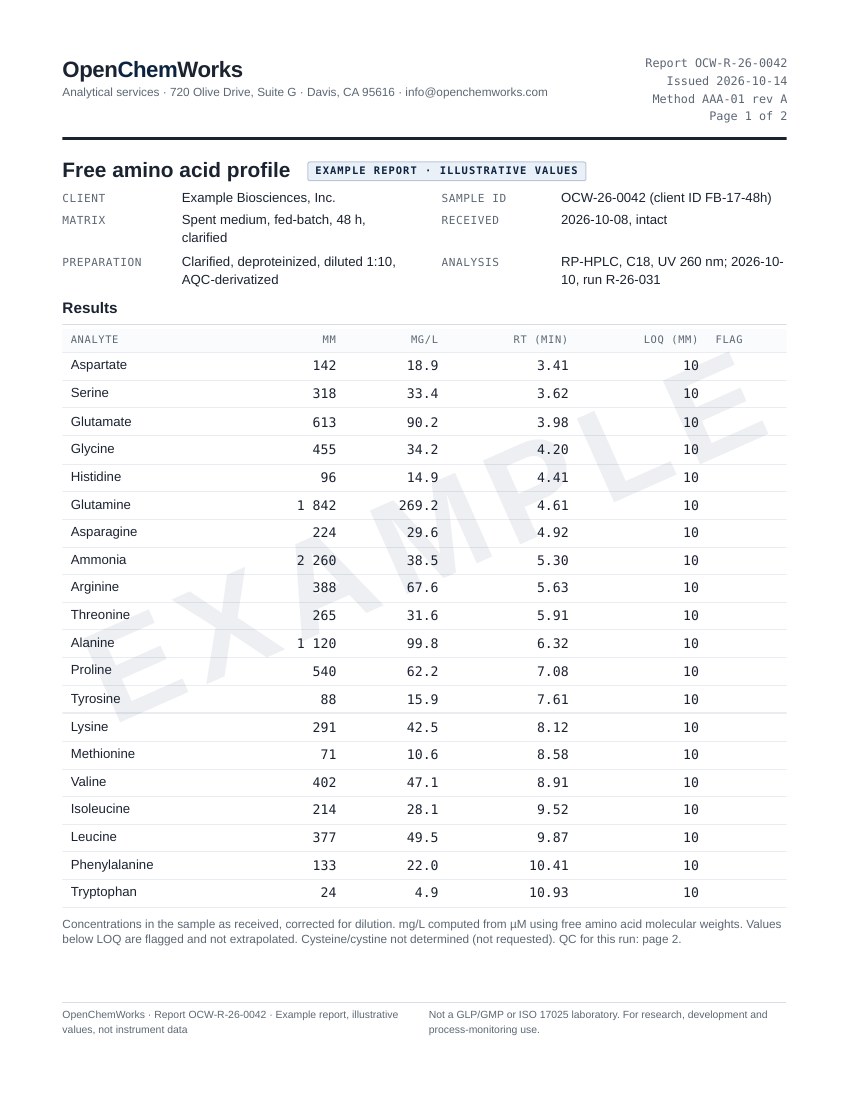
Every result comes with the data behind it.
Each report includes the results table, the chromatogram and the run's quality-control summary, so your methods section or process record has what it needs.
Keep exploring
Related pages: the method behind these results, and the matrices closest to yours.
Cell culture media
Fresh media and feeds: verify what you formulated, including the glutamine–ammonia storage signature.
Explore → JobsSpent Media Analysis
The spent-media job page: sample handling, turnaround framing and what to send.
Explore → ServiceAmino Acid Analysis
The full AA-1 free amino acid panel service: method, deliverables and published prices.
Explore →Validating now — pilot slots reserving
Send the culture day, the run, and whether a matched fresh sample is included. We will confirm the panel, the sample count for your time course, and the all-in price before anything ships.