Is ammonia killing your culture?
How to measure ammonia in cell culture, and what a spent-media sample can tell you in one run: ammonia plus 19 amino acids for $150.
You can measure ammonia with an analyzer, an enzymatic kit, an electrode, or by HPLC. Our HPLC test (AA-1, $150) reports ammonia together with 19 amino acids from one spent-media sample, with the chromatogram in every report. Freeze samples promptly, because ammonia rises in stored samples.
Four ways to measure ammonia in culture
| Method | Good for | Watch for |
|---|---|---|
| Bioprocess analyzer in your lab | Fast, frequent readings next to the bioreactor | You need the instrument, and it does not give the amino acid profile |
| Enzymatic kit on a plate reader | Occasional checks with equipment you already own | One analyte per assay, and you run the kit yourself |
| Ion-selective electrode | Quick readings on a bench | Needs careful calibration and sample handling |
| HPLC with derivatization (our AA-1) | Ammonia and 19 amino acids from the same sample, with a chromatogram | Samples are shipped to the lab, so results are not in-line |
Send samples out when you want ammonia and amino acids together, when you have no analyzer, or when you want a second method to cross-check your own readings.
Ammonia is the suspect with no number on it
Growth stalls. Viability dips. Titers disappoint. Everyone suspects ammonia, the classic inhibitor. Most analyzers and kits are sold as tools, so a lab that simply runs your sample is less common. Our panel measures ammonia alongside 19 amino acids from the same spent-media sample, so depletion and toxicity show up in one view.
Sampling and storage matter for ammonia
- Ammonia rises in stored samples as glutamine breaks down, so freeze samples promptly and do not leave them warm.
- Ammonia is also present as background in reagents and air. A reagent blank runs with the samples, and low results are flagged against the quantitation limit.
- Pull each time point into its own tube, spin out cells, and ship frozen. See how to submit samples.
How to read the result
The report gives ammonia in µM and mg/L next to every amino acid. Read the ammonia curve across time points together with glutamine and glutamate, as in glutamine, glutamate and ammonia across a fed-batch run. A trend shows what the culture produced; it does not by itself prove what limited growth.
Price
AA-1 is $150 per sample ($125 at 15 or more samples a month, $99 at 30 or more a month on a 6-month plan). A whole run of up to 24 time points is $1,990 (RUN-1), against 24 x $150 = $3,600 sample by sample. The order minimum is $150. Standard results in 3 to 5 business days from receipt. Overnight turnaround available, with expedited service on request.
OpenChemWorks Laboratory · Reviewed by the OpenChemWorks laboratory · Updated November 19, 2026
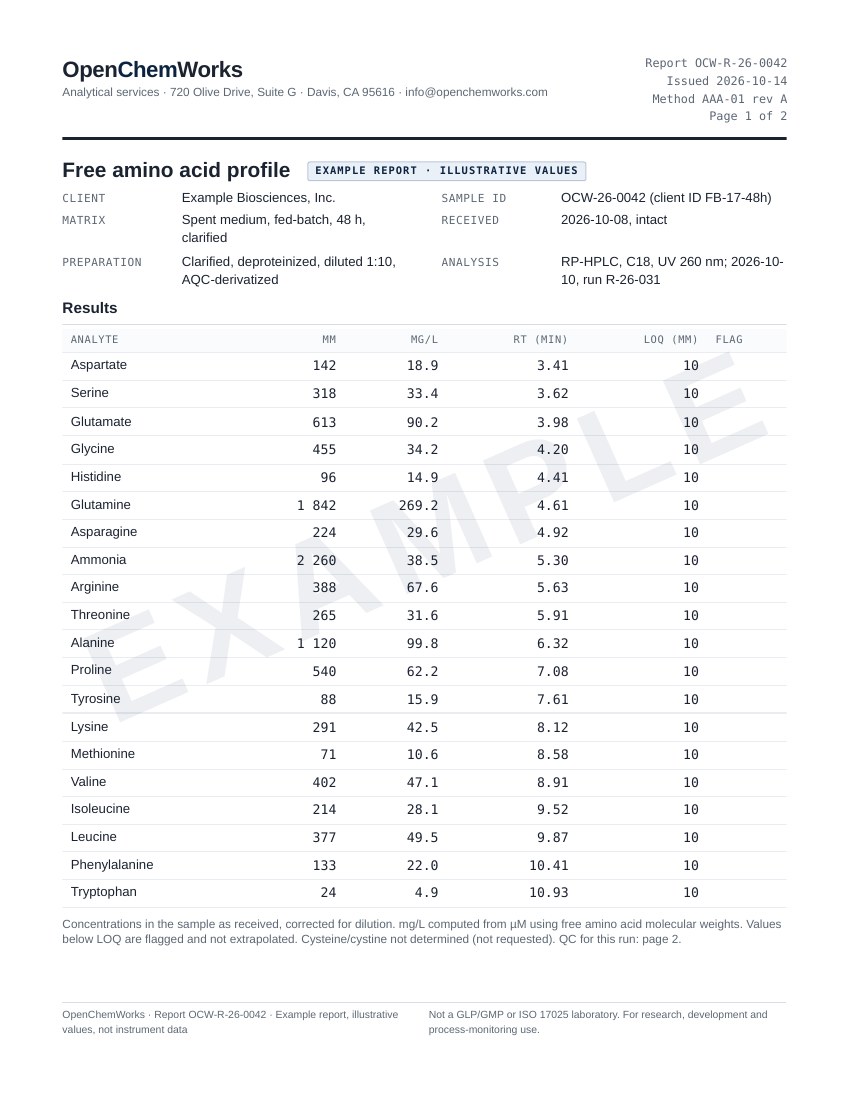
Depletion and toxicity, one sample.
Ammonia plus the amino acid profile from your spent media. See which nutrients are running out and whether ammonia is climbing, the two numbers that decide your next feed. See what an amino acid panel tells you for how to read the profile.
Related testing
Other jobs we help with, and the reading behind this one.
Spent media analysis
Which nutrients are depleting in your culture? Amino acid profiles from spent media.
Explore → JobProtein drink verification
Per-lot protein verification for beverage brands, what’s actually in the bottle?
Explore → ApplicationCell culture media
Glutamine, ammonia, asparagine and essential amino acids in fresh, fed and spent media, for feed design and lot comparison.
Explore →Get the next one in your inbox
Testing guides for your job as we publish them, no spam, unsubscribe anytime.
Have samples in mind?
Pick the tests, the sample type and any preparation. The total updates as you go, and you can book in the same place. Every report includes the chromatogram and QC behind the numbers.
- Free amino acids$150
- Total amino acids$230
- Creatine$120