Is your protein spiked?
The COA on your desk says 85.2% protein. But that number is nitrogen × 6.25 — and you’ve heard about amino spiking.
The test most brands rely on can’t see spiking.
Kjeldahl and Dumas measure nitrogen, then multiply by 6.25 and call it protein. Any nitrogen counts — including the cheap nitrogen-rich additives used in amino spiking.
That’s not a flaw in the method. It’s the method doing exactly what it was designed to do. It’s just blind to the question you’re actually asking: which amino acids are really in this product?
And the economics favor the spiker. A little glycine is a lot cheaper than a little whey — and the standard test can’t tell the difference. Our guide to how to verify amino acids on a supplement label walks through what to ask a lab for.
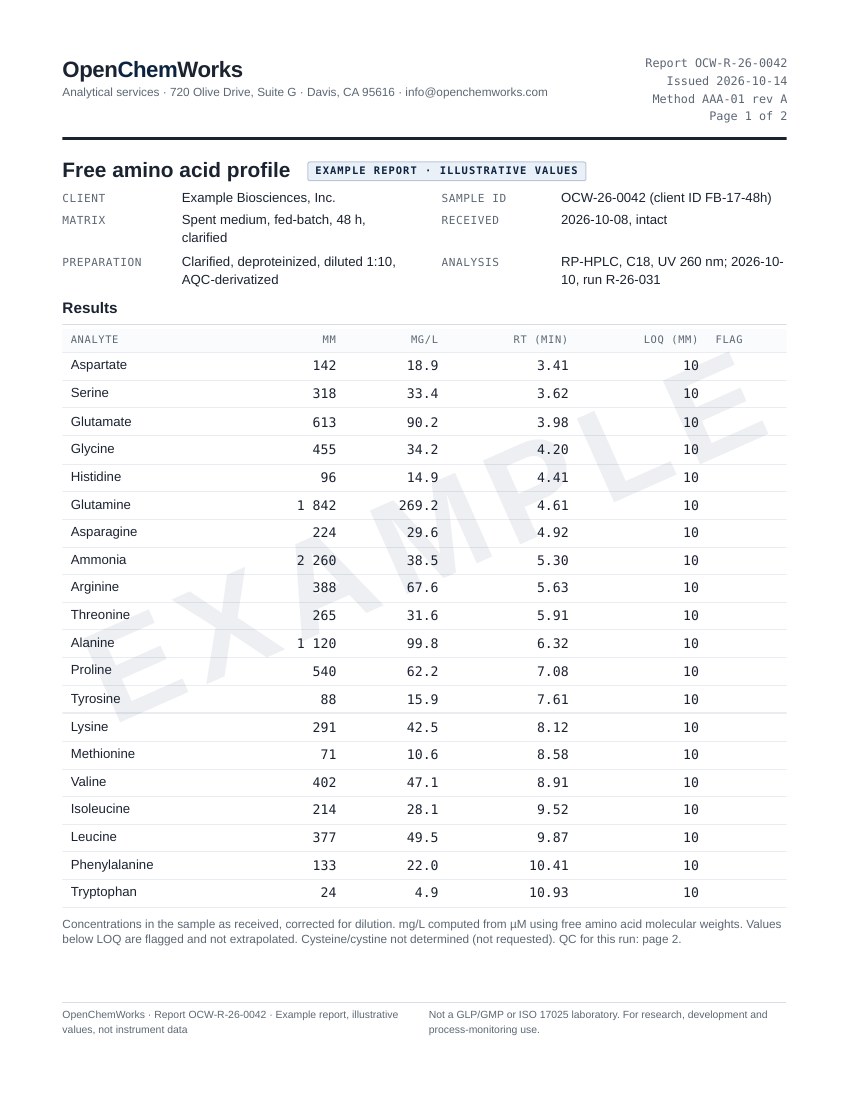
The measurement Kjeldahl can’t make.
A free amino acid panel measures each amino acid individually — not nitrogen, molecules. When a product is spiked, the spiked amino acid shows up as a peak out of proportion to everything else. That’s the reveal. See what an amino acid panel tells you for the full picture on reading the numbers.
Related
More on this job, and the prices behind it.
Spent Media Analysis
Which amino acids are depleting? Is ammonia killing your culture? Data for feed decisions, not guesswork.
Explore →Job pageSupplement Testing Cost
Real numbers: $150 a sample, $125 at 10+, $99 on contract. No quote games.
Explore →InsightHow to Verify Amino Acids on a Supplement Label
What to ask for, what a real report looks like, and the questions that catch a weak COA.
Read →Get the next one in your inbox
New testing guides and lab notes, when they matter. No spam.
Think your protein might be spiked?
We’re validating now and reserving pilot slots. $250 for 5 samples — a deposit, not a discount. The full $250 is credited against your first contract if you sign within 90 days of the report.